Are EV chargers putting Melbourne buildings at risk? Here’s what the evidence says
By James English, CEO, Ace Parking Group and President, Parking Australia
A warning that an EV-sparked skyscraper disaster could be “waiting to happen” in Melbourne is confronting. It is also exactly the kind of claim that should trigger a proper assessment, not an automatic refusal.
In a Herald Sun report published on 12 September 2026, Melbourne fire safety expert Dr Jonathan Barnett warned about installing electric vehicle charging in high-rise buildings without adequate engineering assessment. Dr Barnett told the Herald Sun he was “not opposed” to EVs, but opposed to chargers being installed in buildings without an engineering assessment.
The concern is understandable. The problem is what often happens next.
For many existing buildings, uncertainty around fire risk, electrical capacity, insurance, governance and approvals is not leading to a structured review of the opportunity. It is leading to a default “no”.
I saw the same issue raised directly at Breaking Barriers, Building Charge: Overcoming the Hurdles of EV Parking at RMIT Activator in Melbourne on 26 August 2026, where I participated in the panel discussion. The conversation brought together the parking and EV sectors to examine infrastructure, operations, safety, commercial models and future demand. One theme was difficult to ignore: uncertainty can become a de facto “no” long before the technical, commercial and operational opportunity has been properly assessed.
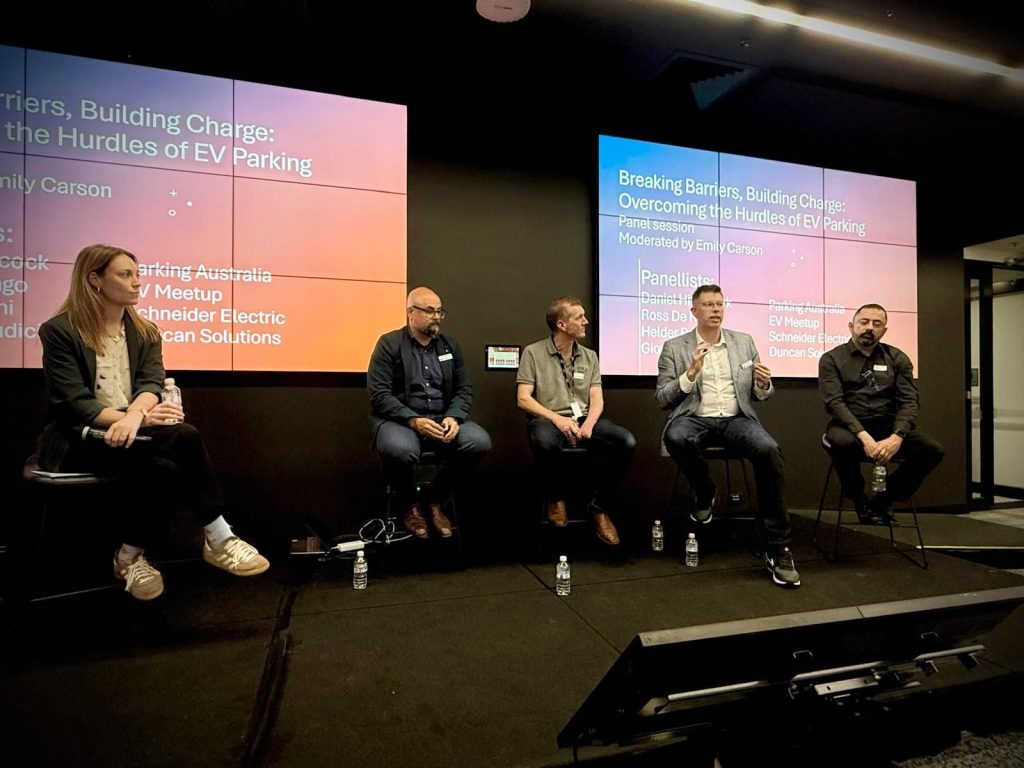
The discussion also challenged assumptions about charging risk, including the question explored later in this article: can a healthy EV connected to compliant charging infrastructure, in some circumstances, gain an additional layer of active monitoring and protection rather than simply adding risk?
That matters because Victoria is trying to expand EV charging at the same time as many buildings are struggling to establish a clear pathway to approve it. Victoria’s 2026 parliamentary inquiry into electricity supply for EVs identified owners corporation approvals and retrofit costs as significant hurdles. Major works can require significant owner approval, which can be difficult to achieve even where a technically viable solution exists.
The better outcome is to assess the technical, commercial and governance pathways together, then decide whether to proceed, stage the works, adopt an interim solution or defer for a defined reason.
Uncertainty should trigger an assessment, not a veto.
What the Australian fire record actually shows
As at April 2026, the Australian Government reported more than 500,000 EVs on Australian roads and 14 recorded EV traction-battery fires since 2021.
For scale, 14 fires compared with a current fleet of more than 500,000 vehicles is equivalent to about 0.0028 per cent, or roughly one recorded traction-battery fire for every 35,700 EVs in today’s fleet.
That is not a formal incidence rate. Australia’s EV fleet has grown significantly since 2021, so today’s fleet size should not be used to calculate a precise historical fire probability. But it does show the order of magnitude involved.
The reported causes of those 14 fires were five high-speed collisions or impacts, three garage fires that spread to the EV, two arson attacks, one bushfire and three incidents still under investigation.
None of the 14 recorded Australian EV traction-battery fires is identified in the Australian Government’s current cause breakdown as having been caused by normal compliant EV charging. Some incidents have occurred while vehicles were connected to charging, but “while charging” is not the same as “caused by charging”.
Now consider the exposure to charging itself.
Victoria’s parliamentary inquiry heard that many drivers travel around 40 kilometres a day and may only need to charge once a week. If Australia’s current fleet of more than 500,000 EVs charged only once a week, that would represent more than 26 million charging sessions in a single year.
That is an illustration, not a measured national session count. Some EVs charge more often and some less. But it highlights an important point: the number of charging events is vastly larger than the number of vehicles.
Against that scale, Australia’s recorded traction-battery fires remain extremely uncommon. The evidence does not support treating every charger installation as though a fire is a likely outcome.
Could a plugged-in EV actually be safer than an unplugged EV?
It sounds counterintuitive, but there is a reasonable theory behind the question.
A healthy road-registered EV connected to compliant charging infrastructure is not simply having electricity pushed continuously into a battery. The vehicle’s battery-management and protection systems monitor the battery and charging process. The charging equipment controls the electrical connection and provides its own protections. Before and during charging, those systems perform checks and can refuse, limit or stop charging when relevant abnormal conditions are detected.
That means a healthy EV connected to compliant charging infrastructure can have an additional active safety-control process that is not present between the property and the same vehicle simply sitting idle and unplugged in a parking bay.
Giving evidence to Victoria’s parliamentary inquiry in March 2026, EV FireSafe Director Emma Sutcliffe told the Committee that “EV charging is inherently safe”. She explained that when an undamaged EV is connected to compliant charging equipment, correctly installed to the applicable standard by a qualified electrician, safety checks take place and the vehicle cannot simply be electrically overcharged until it enters a battery fire.
So, in some circumstances, being plugged in may create an additional opportunity for an abnormal condition to be identified and charging to be interrupted.
But there is an important limit to that proposition.
A charger is not a diagnostic machine. Physical battery damage, cell defects or latent damage may not immediately produce a condition the charging system can identify. Fire authorities advise that a damaged or submerged EV, or one exposed to fire or high heat, should not be charged or used until it has been inspected and cleared by a qualified technician.
So the answer is not that plugging in makes every EV safer.
The defensible conclusion is that compliant charging adds an active layer of monitoring and electrical protection to a healthy vehicle. It should never be used as a test of whether a damaged vehicle is safe.
“While charging” is a circumstance. “Caused by charging” is a finding.
This distinction matters because around 15 per cent of EV battery fires in EV FireSafe’s global dataset occurred while a vehicle was connected to charging or within an hour of being disconnected. That can sound alarming until causation is examined.
EV FireSafe’s research shows that charging-connected fires can involve a pre-existing battery defect, earlier collision damage, submersion, an external fire or another underlying cause. Connection itself does not establish charging as the cause.
A car can catch fire at a petrol station without petrol being the cause. The same discipline should apply to EV incidents.
Victoria’s battery-fire problem is broader than electric cars
This distinction is particularly important in Victoria because the state does have a growing lithium-ion battery fire problem.
But it is not primarily a road-registered EV problem.
In March 2026, Energy Safe Victoria issued an urgent warning after five lithium-ion battery fires occurred across the state in just 24 hours. Three involved e-bikes, one involved a drone and the fifth involved another rechargeable device under assessment. None was a road-registered EV.
Fire Rescue Victoria has also distinguished the relatively rare risk from road-registered EVs from the growing risk associated with battery-powered micro-mobility devices such as e-scooters and e-bikes.
Headlines about “lithium-ion battery fires” can therefore be interpreted as evidence about electric cars when the underlying incidents may involve a completely different product category, battery standard, charging equipment and regulatory environment.
Rare does not mean irrelevant
None of this means the consequences of an EV battery fire should be dismissed.
This is where the issues raised in the Herald Sun article become relevant. The consequence of thermal runaway inside a particular building can be significant. An EV battery fire can involve intense heat, toxic and flammable gases, prolonged cooling, the potential for reignition and significant demands on emergency responders.
The location of charging infrastructure also matters. A charger near critical building services, poor emergency access, inadequate electrical infrastructure or an unsuitable fire strategy deserves proper scrutiny.
But risk has two components: likelihood and consequence.
A difficult fire is not necessarily a likely fire.
Good risk management should examine both. It should not use the severity of a possible event as a substitute for understanding how likely that event is, or what controls can reduce the risk further.
This is not just a basement-car-park question
EV charging can be installed in underground basements, enclosed multi-storey car parks, open-sided decks, rooftops, shopping-centre forecourts, external car parks, hospitals, workplaces and other destination parking environments.
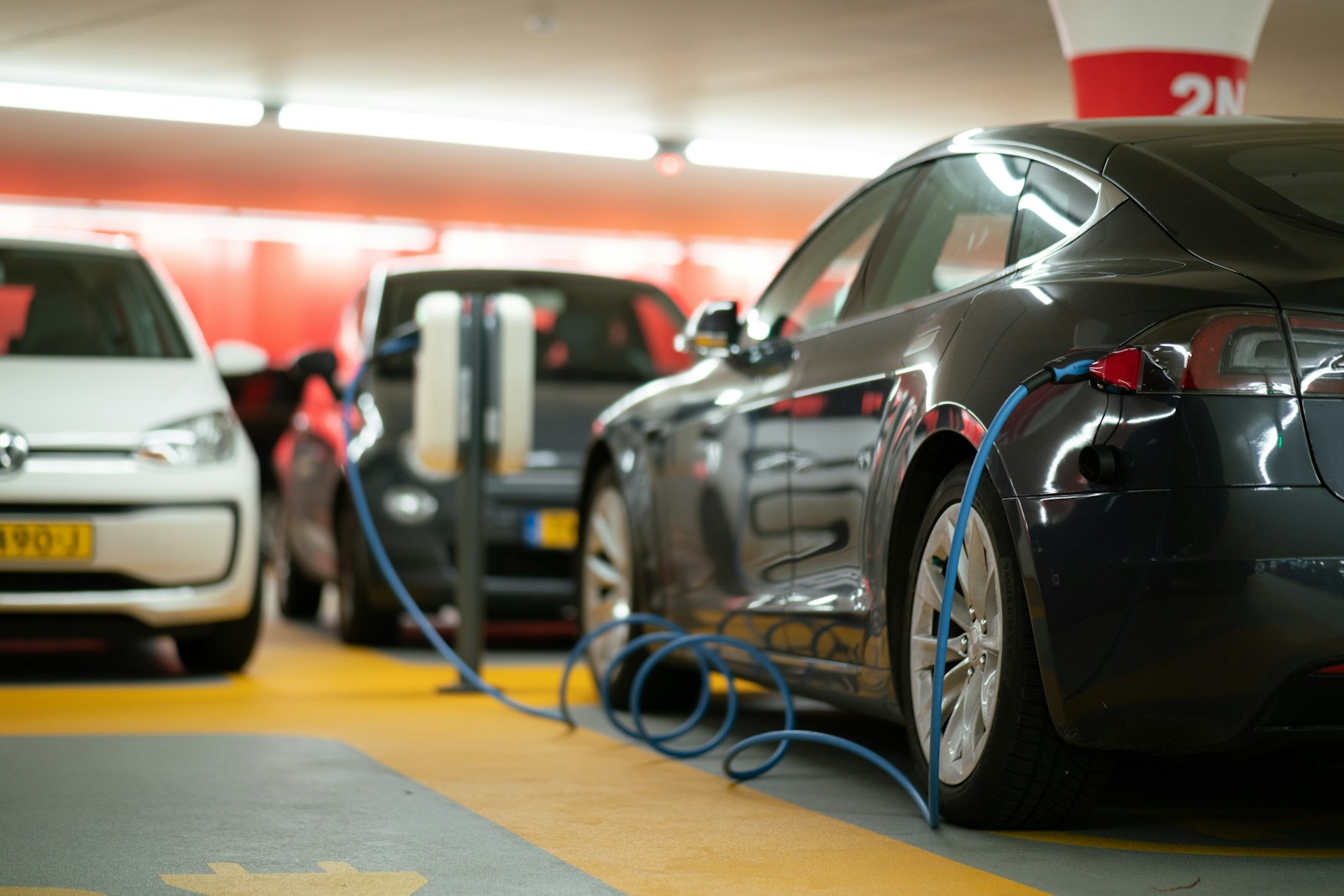
Those environments are not equivalent.
A rooftop charger has different ventilation, emergency access and exposure conditions from a charger several levels underground. A forecourt beside a shopping centre has different surrounding infrastructure from a residential tower. A hospital car park has different operating priorities again.
This is why a blanket question such as “Are EV chargers safe in buildings?” is not especially useful.
The better question is: what charging solution is appropriate for this asset, in this location, with these controls?
The answer should be a pathway, not a roadblock
The biggest opportunity now is to give property owners, owners corporations and asset managers a clearer path from concern to decision.
Victoria’s current approach to EV-ready buildings points in the right direction because it does not assume every property should immediately install the same charging system. Buildings need to consider three connected questions:
- Technical: what is safely and practically achievable within the building’s electrical and physical constraints?
- Commercial: who funds, owns and manages the infrastructure, and how are electricity and ongoing costs allocated?
- Legal and governance: what approvals are required, particularly where common property or owners corporation decisions are involved?
That process can lead to a building-wide installation. It can also lead to staged works, a shared charging solution, an interim approach or a reasoned decision to defer.
The important difference is that the decision follows an assessment.
A “no” without understanding the opportunity is not risk management. It is simply uncertainty winning.
The property should drive the solution
For owners, asset managers and designers, EV charging should begin with the asset rather than with a charger count.
Relevant considerations can include where charging is located, whether the area is enclosed or open, existing fire and electrical infrastructure, emergency-service access, isolation and shutdown capability, impact protection, inspection and maintenance, treatment of damaged vehicles, adjacent services, customer movements and how charging interacts with the wider operation of the property.
This is consistent with the broader risk-control approach set out by WorkSafe Victoria, which addresses compliant electrical installations, shutdown controls, obvious battery damage, emergency arrangements and inspection and maintenance.
Not every property requires the same controls or the same level of intervention. The controls should follow the actual risk.
That is why the current debate should not resolve into “chargers in buildings are dangerous” or “EV fires are too rare to worry about”. Both positions are too simplistic.
The answer is not less charging. It is better charging, supported by a clearer route to approval.
Australia and Victoria will need substantially more charging infrastructure as EV adoption grows. New buildings are increasingly being designed to accommodate that transition. The harder challenge is the existing building stock, where technical questions, governance, cost and fear can combine to stop projects before the opportunity has even been properly assessed.
There is enough evidence to do better than that.
EV traction-battery fires are rare. None of the 14 recorded Australian EV traction-battery fires is identified in the Australian Government’s current cause breakdown as having been caused by normal compliant EV charging. Victoria’s parliamentary inquiry found EV fire risks to be low and commonly misunderstood. Fire Rescue Victoria distinguishes the relatively rare risk from road-registered EVs from the growing problem associated with micro-mobility batteries. Compliant charging introduces safety checks and electrical protections. And when a battery fire does occur, the consequences and the surrounding building environment still require proper consideration.
Those facts should not produce complacency.
They should produce a better assessment process.
At Ace Parking, we believe parking infrastructure should serve the priorities and operating environment of the property around it. EV charging is no different. Our approach to parking technology and sustainability starts with the asset, the user journey and the operating environment rather than the technology in isolation.
Understand the asset. Understand the actual risk. Establish the pathway to approval. Then design the charging solution around all three.
If your property is assessing EV charging and the pathway has stalled at uncertainty rather than evidence, talk to Ace Parking about the parking and operational considerations that should form part of the wider property assessment.
About James English
James English is CEO of Ace Parking Group and President of Parking Australia. He works across parking operations, property strategy, technology and emerging mobility, including the practical integration of EV charging into existing and new parking environments.
Sources and further reading
- Herald Sun: Melbourne EV fire-safety report, 12 September 2026
- Parking Australia and EV Meetup: Breaking Barriers, Building Charge, 26 August 2026
- Parliament of Victoria: Inquiry into Electricity Supply for Electric Vehicles, Final Report, 2 June 2026
- Parliament of Victoria: evidence of Emma Sutcliffe, EV FireSafe, 12 March 2026
- Australian Government: Electric vehicle facts
- Fire Rescue Victoria
- WorkSafe Victoria: Working on hybrid and electric vehicles safely
- EV FireSafe: EV fire and charging research