Melbourne Congestion Levy 2026: Rates, Exemptions & Owner Guide
Victoria’s congestion levy is an annual charge on certain off-street parking spaces in defined areas of inner Melbourne. For the 2026 levy year, the Category 1 rate is $3,030 per leviable space and the Category 2 rate is $2,150 per leviable space.
Ace Parking has maintained information on Melbourne’s congestion levy on this URL since 2014. The current guidance is kept at the top of the page, with the original historical context retained further below.
For property owners and asset managers, the statutory rate is only part of the issue. The commercial question is how the levy interacts with the actual use, allocation and performance of the parking asset.
Disclaimer:
This guide provides general operational and commercial information only. It reflects Ace Parking’s interpretation of the relevant parking levy framework and is not legal or taxation advice.
Each state has its own responsible government authority for the administration, application and collection of parking levies, and those authorities remain the definitive source for statutory requirements, liability, exemptions, concessions, registration, returns and assessments.
Rates, rules, boundaries and administrative requirements can change. Every property, parking arrangement and statutory position is different. Owners and operators should confirm their specific circumstances with the relevant government authority and obtain appropriate professional advice where required.
Melbourne congestion levy 2026 at a glance
- Category 1: $3,030 per leviable parking space.
- Category 2: $2,150 per leviable parking space.
- The 2026 assessment is based on how parking spaces were used during 2025.
- Liability is tied to the owner or operator position on 1 January, subject to the detailed rules applying to the particular car park.
- Category 2 expanded from 1 January 2026 into additional inner-Melbourne areas.
- Spaces used exclusively for residential purposes are no longer subject to the levy from 2026, subject to the statutory conditions.
- A 50% concession may apply to qualifying retail customer parking in Category 2.
The State Revenue Office Victoria publishes the current mapped levy areas, rates, exemptions and concessions. Owners should check the current SRO guidance for an individual property rather than relying on suburb names or historic boundaries.
What changed in 2026?
The 2026 changes materially increased both levy rates and expanded the Category 2 area into additional inner-eastern locations including Burnley, Cremorne, South Yarra and Windsor, as well as parts of Richmond, Abbotsford and Prahran. The Queen Victoria Market area also moved from Category 1 to Category 2.
The treatment of residential parking also changed from 1 January 2026, and a 50% concession was introduced for qualifying retail customer parking in Category 2. The applicable statutory conditions should be confirmed directly with the SRO.
Why the levy matters operationally
The statutory levy is expressed per leviable space, but that does not tell an owner whether the parking asset is being used effectively. A site with under-used allocations or poorly matched demand can carry the same statutory charge while generating materially less operational or commercial value.
Ace uses the concept of a productive space as an operational management measure. It is not a statutory definition. A productive space is one that contributes to the intended parking outcome through revenue, tenant service, customer access, staff access or another defined property objective.
This distinction is useful because the strongest response to a levy increase may not be a simple tariff increase. Depending on the property, the opportunity may instead sit in allocation, product design, utilisation, capacity sharing, access rules or technology.
What should an owner review?
A practical operational review may consider the current parking inventory, tenant and staff allocations, customer and visitor demand, utilisation by time and user group, access-control data, parking products and tariffs, redevelopment impacts and changes in tenancy or ownership.
Operational records can help establish what is occurring within the parking asset. They do not themselves determine legal eligibility for an exemption or concession.
Do not automatically pass the levy through to customers
A higher statutory cost creates pressure to recover cost, but a dollar-for-dollar increase in parking tariffs is not automatically the strongest commercial response. Demand, competing alternatives, occupancy, tenant or customer sensitivity and the broader role of parking within the property should be considered first.
How Ace Parking can assist
Ace Parking can support owners and asset managers with the operational and commercial analysis surrounding levy-affected parking. This can include parking inventory and utilisation analysis, allocation reviews, tariff and product strategy, occupancy and demand analysis, access-control and parking-technology review, redevelopment parking impacts and operating-model assessment.
Discuss the operational impact of the levy on your parking asset
History of the Melbourne congestion levy
The following section preserves the historical context that originally made this page useful. Rates, boundaries and policy references below are historical and should not be relied on for current statutory decisions.
This page was originally developed around the major expansion announced in the 2013–14 Victorian State Budget Update, when the congestion levy boundary was extended and a new Category 2 area was introduced from 1 January 2015.
At that time, the Category 1 levy had risen from $960 to $1,300 per space in 2014, while the new Category 2 area was introduced at $950 per space. The page was subsequently updated with the 2016 and 2017 levy rates and commentary on the growing gap between Melbourne and Sydney levy settings.
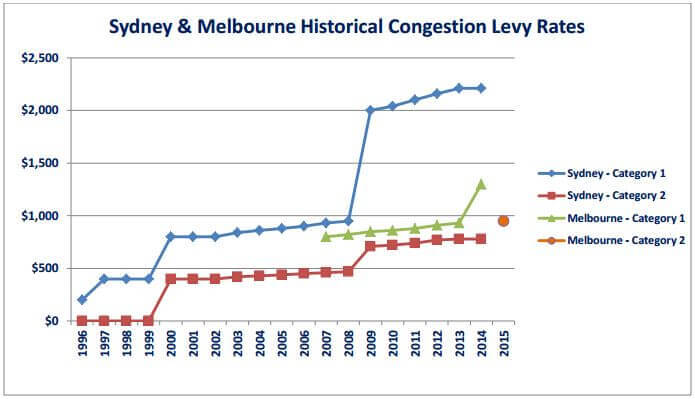
The original Ace commentary questioned whether a levy focused on off-street parking could achieve congestion objectives while on-street parking remained outside the scheme. It also documented the 2015 expansion of the levy area and the industry debate that followed.
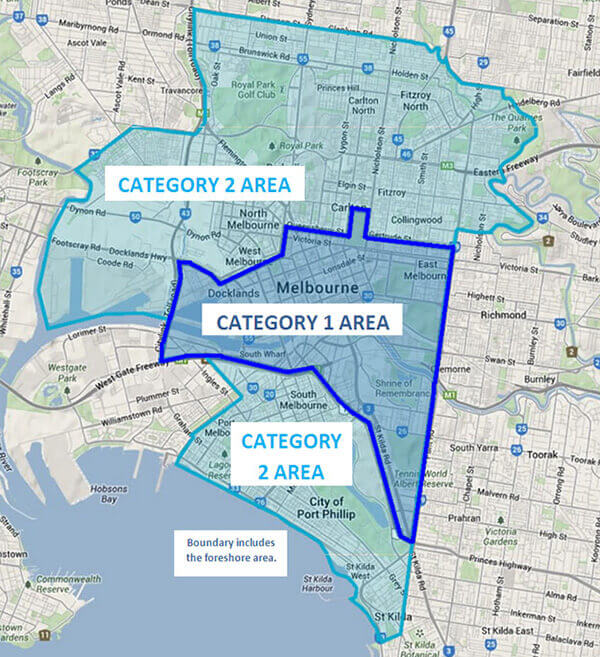
The original page also collected contemporaneous media coverage, State Revenue Office information and parking-industry commentary. That historical material is retained here as context, while current rates, exemptions, boundaries and administrative requirements should always be checked against the official sources below.
Official sources
- SRO: Understanding the congestion levy
- SRO: Current congestion levy rates
- SRO: Congestion levy concessions
Readers should confirm the current position with the State Revenue Office Victoria before relying on rates, boundaries, exemptions, concessions or administrative requirements.